The Best Unguided Meditation App of 2026 — ZenMonkey Review
Why We Built a Meditation App That Doesn't Say a Word
In early 2026, after the Lunar New Year buzz had faded, I wanted to get back into a quiet mindfulness routine. I opened up a handful of the top meditation apps on my phone and tried them one by one.
Headspace's warm baritone. Calm's gentle narrator. Tide's rain-on-windowpanes. Every single one of them was filling my ears with beautifully produced audio. And they do it well — so well, in fact, that it's easy to assume this is what meditation is.
But there was a question I couldn't shake: what if someone doesn't want to be told how to breathe? What if they just want to sit quietly and practice on their own?
I'm not making this up. We've spoken to people who practiced meditation for three years and went from paying Calm subscribers to "I just use a phone timer." When we asked why, one of them said: "That voice helped me at first. Then it became noise."
The meditation app market isn't exactly starving for options. But nearly every product is racing in the same direction: more courses, bigger-name instructors, richer sound libraries. They're all becoming content platforms. Nobody has seriously asked: can a meditation tool just be a tool?
This is the story of why we at iiisle Studio went the opposite way — and how we built ZenMonkey, a meditation timer that redefines what a mindfulness app can be by saying absolutely nothing.
Key Takeaways
- 15 minutes of daily mindfulness meditation can shrink the amygdala by up to 19% in 8 weeks (Harvard Medical School) and reduce cortisol levels by roughly 25% (Max Planck Institute)
- Unguided meditation frees you from dependence on an external voice — you become the authority of your own breath
- ZenMonkey is built around a minimalist timer: no voice guidance, no content library, just a tool
- Apple Watch heart rate trend visualization makes post-meditation relaxation visible for the first time
- All data stored locally + iCloud sync. No account needed. Nothing touches a server.
The Science: What Your Brain Does in Silence
Before we get into why we built a meditation app that doesn't talk, let's talk about what meditation actually does inside your head.
You sit there. Eyes closed. Looks like nothing's happening. But your brain is undergoing real, structural change.
Stress hormones drop — measurably. Research from the Max Planck Institute for Human Cognitive and Brain Sciences found that after mindfulness training, cortisol levels in participants' hair dropped by about 25% on average. Cortisol is your body's primary stress hormone. The lower it is, the harder it is for anxiety to hijack you.
Your amygdala literally shrinks. A Harvard Medical School study showed that 15 minutes of daily mindfulness meditation over 8 weeks can reduce grey matter density in the amygdala — the brain's fear and stress center — by up to 19%. You're not "suppressing" anxiety. It's physiologically diminishing.
There's more happening simultaneously. fMRI research from the Shanghai Mental Health Center found that meditators showed heightened prefrontal cortex activity while amygdala activation dropped by 41%. The prefrontal cortex governs rational decision-making and emotional regulation. The more active it is, the better you are at hitting the brakes when emotions spike.
Sleep and focus improve too. Data from the American Academy of Sleep Medicine shows insomnia patients who underwent meditation intervention fell asleep 55% faster and improved sleep efficiency by 30%. On the focus front, 8 weeks of daily meditation improved Stroop Test reaction times by 23%. Google's internal "Search Inside Yourself" program boosted employee focus by 20% and emotional awareness by 35%.
Taken together, meditation's effects are real, physiological changes — not mysticism. But all this research led us to a question we kept coming back to while designing ZenMonkey: do you really need a voice in your ear to get these benefits?
Why Some People Don't Need Voice Guidance — The Case for Self-Directed Practice
The Limits of Guided Meditation: When You Get Used to Being Told What to Do
After talking to dozens of meditators, we noticed a recurring pattern: guided audio lowers the barrier to entry, but it can also — unintentionally — create dependency.
Multiple people told us the same thing: "Without headphones, without a guided track, I don't know how to meditate anymore." The voice that helps you focus also quietly occupies part of your attention. A piece of you is always tracking "what's she going to say next" instead of truly resting with your breath.
It's like someone holding the back of your bike for two years. You've been riding the whole time — but you've never actually balanced on your own.
This isn't guided meditation's fault. Guided audio is a great on-ramp. The problem is that almost every meditation product on the market stops at "beginner mode." Nobody has built a path for people who are ready to move forward on their own.
The Core of Self-Directed Practice: You Are the Authority of Your Own Breath
Self-directed meditation — also called unguided or silent meditation — is built on a simple idea: you don't need anyone to tell you how to breathe.
Your body already knows what to do. All you need is a timer. Set the duration, press start, and sit with yourself in silence for a while. No voice interrupting your focus. No instructions pulling you out of deeper states.
From this perspective, what a silent meditation timer offers isn't "content" — it's space. A genuinely private inner space that belongs entirely to you. This was our north star when designing ZenMonkey.
The Progression: From Guided to Self-Directed
If you're new to meditation, guided audio absolutely helps — it teaches you the fundamentals. But after a few dozen sessions, the real direction of growth is: gradually reducing your dependence on external guidance and moving toward self-directed practice.
There's no hard rule for this. You can start with "5 minutes guided + 5 minutes silent" and transition toward complete silence over time. What matters isn't how long you've been meditating — it's whether you're actually meditating on your own.
We built ZenMonkey to be the destination at the end of that progression. A place you can come when you no longer need someone to teach you how to breathe.
How We Built a Meditation App That's Just a Timer
When we started sketching ZenMonkey's first prototype, we gave ourselves one iron rule: if a feature might distract the user, we don't build it.
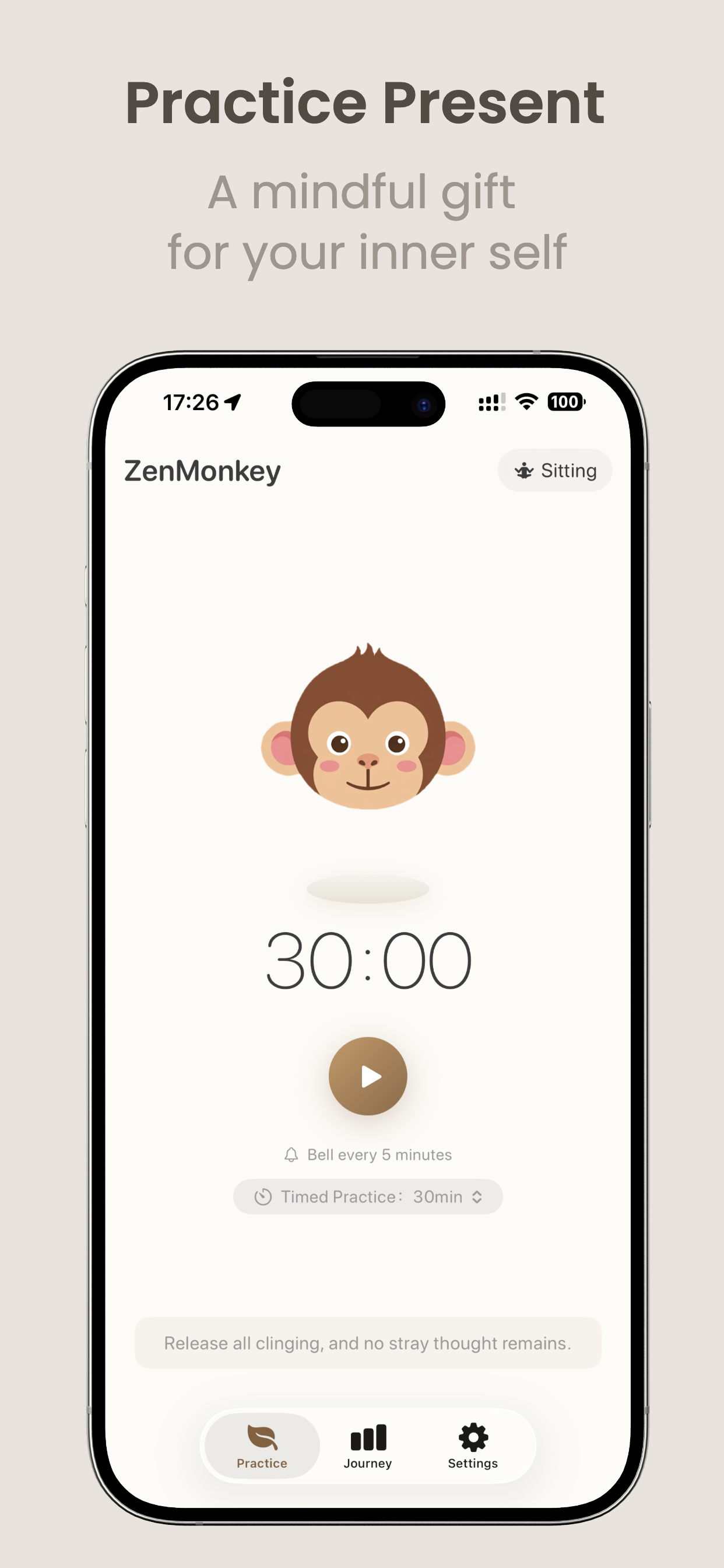
This meant no course recommendations. No daily picks. No community feed. You open the app and you see a timer. A few essential settings. That's it. Our positioning is unambiguous: this is not a content platform. This is a tool.
What Makes ZenMonkey Different
1. No voice guidance. This was ZenMonkey's founding design decision. No male voice, no female voice, no "bring your attention to..." instructions. You set the time, you press start, and then — silence. We chose to trust that you can meditate on your own. That trust itself is a form of respect.
2. Apple Watch heart rate insights. After every session, ZenMonkey shows a heart rate trend curve for the entire meditation period. You can see exactly how your heart rate changed from start to finish — that slow, steady downward slope is visual proof that relaxation is actually happening. This is one of the features we're proudest of: it doesn't "score" your meditation. It just shows you, objectively, what your body did.
3. Privacy by design. All meditation data stays on your device and syncs via iCloud to your own hardware. Nothing ever touches our servers. No account sign-up. No email. No phone number. Open the app, meditate, close it. We believe your meditation practice is between you and yourself — no company needs to be in the room.
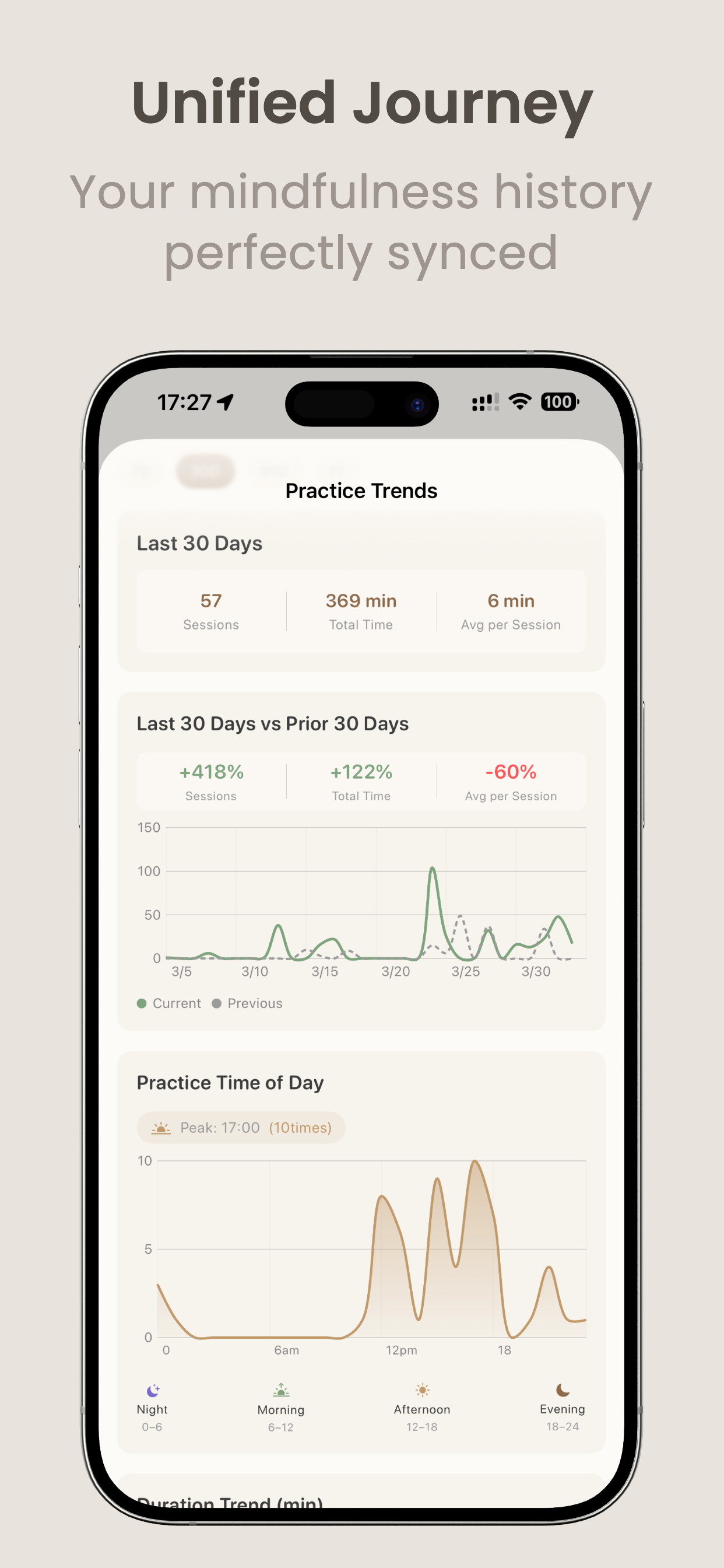
4. Long-term practice trends. A single session's heart rate dip is just a snapshot. The real transformation happens over longer timescales. ZenMonkey aggregates weeks and months of your meditation data, showing trends in practice frequency, session duration, and average heart rate. You can watch yourself go from "I can barely sit still for 3 minutes" to "10 minutes a day is my baseline." That kind of self-witnessed progress across time is more powerful than any leaderboard or streak badge.
Beyond these core principles, we obsessed over the details. The timer screen is the timer — nothing else. No "today's recommended course" pop-ups. Core features are free; Pro is an optional upgrade. Not a "free trial that auto-bills after 7 days" situation. We don't even nag you to subscribe.
Compared to Calm and Headspace, ZenMonkey isn't even playing the same game. We don't sell content — we sell the right to be left alone. We're rated 5.0 stars on the App Store. Not a huge number of users, but the ones who get it really get it.
ZenMonkey vs. mainstream meditation apps:
| ZenMonkey | Calm / Headspace | Insight Timer | |
|---|---|---|---|
| Guidance style | No voice guidance | Voice-guided | Voice-guided |
| Core feature | Minimalist timer | Content library + courses | Content library + community |
| Apple Watch | Heart rate curve visualization | Basic heart rate data | Not supported |
| Data privacy | Local + iCloud, no account | Account required, cloud storage | Account required, cloud storage |
| Pricing | Core free, Pro optional | $69.99/year subscription | Mostly free |
Four Real-Life Scenarios: One Timer, Endless Use Cases
When designing ZenMonkey, we didn't work from a feature checklist. Instead, we kept coming back to real situations and asked: what does someone actually need in this moment?
Scenario 1: Stress Relief — A 3-Minute Breathing Room When Anxiety Hits
One of our early testers described a day when she'd sat through four back-to-back meetings. By the end, her palms were sweating. Not "a little stressed" — heart racing, mind blank, sitting at her desk unable to do anything.
In that state, opening a meditation app that asks you to browse courses and pick a guided track only adds friction. She opened ZenMonkey, set 3 minutes, didn't put on headphones. Just sat at her desk, closed her eyes, and listened to her own breathing.
Three minutes later, she told us: "My heart went from I need to escape to okay, I can handle this."
This is exactly what we optimized for: when anxiety spikes, you shouldn't need 30 seconds to pick a course. You should need one tap. This is the core value of mindfulness-based stress reduction — it's not about eliminating the stressor, it's about changing your physiological response to it. A work-break meditation doesn't require elaborate rituals. A minimalist timer is all you need.
Scenario 2: Focus Training — Swapping Your Morning Coffee for Meditation
Someone on our team developed a habit during ZenMonkey's development: instead of reaching for coffee first thing in the morning, they'd set ZenMonkey for 10 minutes, sit by the window, and take in nothing. No phone, no audio, no input.
The effects were gradual. The first few days felt like nothing — maybe even a bit drowsy. But by week two, morning focus was noticeably steadier. That impulse to "open a document but somehow end up on Slack" had significantly weakened. Focus training doesn't need a fancy curriculum. What matters is doing it every day — even just five minutes. This is why we made the timer so absurdly simple: to lower the barrier to entry until you have no excuse not to start.
Scenario 3: Sleep Support — 10 Minutes Before Bed, With a Heart Rate Curve to Back It Up
Over 300 million people in China suffer from sleep disorders. We have friends who struggle with this — not severe insomnia, but the kind where your mind won't shut off and falling asleep takes forever.
The move is simple: open ZenMonkey before bed, set 10 minutes, put the phone face-down on the nightstand. Don't look at the screen. Don't track the time. Just lie there and feel your breath. When the ending chime sounds, roll over — and usually, you're out.
We once got a note from a user who wore her Apple Watch during one of these sessions. Over those 10 minutes, her heart rate dropped from 78 to 62. Her normal resting rate was around 72. That ten-minute window was lower than her actual sleep. She wrote: "That slow downward curve reassured me more than any sleep score ever has. It told me — your body really is relaxing. You're not just telling yourself a story."
Feedback like that is why we keep building ZenMonkey. If you're looking for a pre-sleep meditation timer, the silent design is particularly suited to it — no headphones needed, no disturbance to the person next to you.
Scenario 4: Commute Mindfulness — No Headphones, No Problem
Morning rush hour on the subway. Everyone has earbuds in — scrolling short videos, listening to podcasts. I used to be one of them.
The commute is actually an overlooked meditation opportunity. You don't need a perfectly quiet environment — that's exactly where unguided meditation shines: you don't need to hear anything. Stand there, close your eyes (or half-close them), and bring your attention to your breath. The surrounding noise becomes a kind of white noise.
Five minutes later, you open your eyes. The world is still the same crowded morning rush — but there's an extra layer of buffer between you and it. This is a core belief we built into ZenMonkey's unguided design: meditation doesn't require perfect conditions. You can be with yourself, anywhere.
Apple Watch Heart Rate Insights: Making the Invisible Visible
Of everything we built into ZenMonkey, Apple Watch heart rate insights took the most time to get right.
Apple Watch has a built-in "Mindfulness" app, but it only does guided breathing. At the end, it gives you a single heart rate number. Just a number. No trend, no context. We thought that was nowhere near enough — meditation's relaxation effect is a process, not a single data point.
So we did it differently. ZenMonkey records your heart rate across the entire session and generates a curve. You can see where you started, whether there were fluctuations in the middle, and where you ended up. Over weeks and months, you can see trends across multiple sessions. For the first time, the fact that your body is learning to relax becomes quantifiable.
Why does this curve matter? Because meditation has an inherent weakness: its effects are deeply internal. It's hard to prove to yourself that "I was genuinely more relaxed today than yesterday." But a heart rate curve can. When you see your ending heart rate 5 beats lower after your 30th session than your first — that sense of progress is real and earned.
We spent a long time polishing this feature, not to show off, but because quantifiable feedback is the most powerful motivator for sticking with a meditation practice.
Privacy: Your Meditation Data Belongs to You
There's one more thing we feel strongly about that the industry rarely addresses seriously: where does your meditation data go?
Most major meditation apps require you to create an account — email, phone number, sometimes social login. Your session length, frequency, preferences, even heart rate data if you connect a wearable — all of it lives on their servers. You have no idea how it's being used or whether it's being shared with third parties.
To us, this makes no sense. Meditation data might be more intimate than your chat history. It reflects your emotional cycles, stress levels, and sleep patterns. No company should hold that.
So we made a technical decision from day one: everything stays on your device, synced to your own hardware via iCloud. No account required. No personal information collected. Your meditation is between you and yourself — we just provide the tool. We don't look, we don't store, we don't transmit. (More on our design philosophy at the ZenMonkey website.)
It's 2026. The idea of handing over your email and phone number just to sit in silence feels increasingly wrong. This might matter more than any feature.
FAQ
What kind of meditation app is ZenMonkey? ZenMonkey is a minimalist, self-directed mindfulness timer for iOS. The core design philosophy is no voice guidance — just a timer. It's built for people who already know how to meditate and want to own their rhythm, as well as practitioners ready to graduate from guided sessions to silent practice.
Does ZenMonkey support Apple Watch heart rate monitoring? Yes. After every session, ZenMonkey displays a heart rate trend curve covering the entire meditation period, so you can see how your heart rate changed from start to finish. Over time, you can view multi-session trends, making your relaxation progress measurable.
Do I need to create an account or subscribe? No. ZenMonkey requires no account. All meditation data is stored locally and synced via iCloud to your own devices. Nothing is ever uploaded to our servers. Core features are completely free. Pro is an optional upgrade — not a forced subscription.
What's the difference between guided and unguided meditation? Guided meditation uses voice instructions to tell you how to breathe and where to place your attention — great for beginners. Unguided meditation (also called silent or self-directed meditation) has no voice instructions — just a timer, and you're in control. It avoids dependency on external voices and is ideal for practitioners who have built a foundation and are ready to move toward self-directed practice.
Get ZenMonkey on the App Store
If you've made it this far, you probably feel some resonance with the idea of "undisturbed quiet."
ZenMonkey is a meditation app we built with care, available on the Apple App Store as a free download. Core features are completely free. Pro is an optional upgrade — not a forced subscription, and we won't pester you with pop-ups.
Download ZenMonkey for free on the App Store →
First-time suggestion: after downloading, just set a 3-minute timer. Don't put on headphones. Find a quiet spot, sit down, close your eyes, and feel your breath. That's it. The timer will handle the time. You just handle yourself.
Closing
Let's return to the question we started with: what are we actually practicing when we meditate?
After building a mindfulness product for two years, we've come to believe one thing: the best meditation tool isn't the one that tells you the most. It's the one that knows when to shut up.
That's why we made ZenMonkey the way it is. No talking. No guiding. No pushing. It doesn't even pester you to subscribe. It gives you a timer, a stretch of silence, and a heart rate curve you can see.
If you're tired of being told how to breathe, try meditating without headphones. Just 3 minutes today.
Some things don't need to be done for you. Breathing is one of them.
For more on mindfulness and minimalist living, visit the ZenMonkey website.
References:
Shanghai Mental Health Center fMRI meditation study. Heightened prefrontal cortex activity with 41% reduction in amygdala activation.
8 weeks of daily meditation improved Stroop Test reaction times by 23%. Study on focus and attention.
2025 China Sleep Health Survey Report. Over 300 million people in China suffer from sleep disorders.